


When the math department at Cuyamaca College—where I am the dean of math, science, and engineering—analyzed the success rates of our students in 2010, the results jolted us awake. Only 4 percent of students who started in prealgebra had successfully completed a transfer-level math class.
The data weren’t much better for students who started in other remedial math classes.
We decided to make some major changes.
Working with the California Acceleration Project, we started to unpack what math students actually needed to stay on track, giving a fresh look at our offerings. That led us to create a new course, pre-statistics, for students who needed a course such as statistics or liberal arts math as part of their major—approximately 70 percent of students at Cuyamaca. This open-access course led students straight into statistics.
It worked. More than 65 percent of students who started in that class successfully completed statistics, a course that did not change.
Other colleges saw similar results. A 2014 study of other community colleges in California shows that the odds of completing a transferable math course were 4.5 times greater in this pathway than those for students in traditional remediation. To add to this, students of all ethnic backgrounds benefited from this experience.
Seeing this success, we asked how we could help all students at Cuyamaca College, rather than just those who needed statistics. In fall 2016 Cuyamaca College made two huge changes.
Based on research done by the Multiple Measures Assessment Project, we changed our placement system to include a self-reported questionnaire. This meant students would be placed into math based on their high school GPA and math courses taken.
In addition, following a trend we saw working in Tennessee and elsewhere, we moved to offer corequisite courses—courses students take alongside the transfer-level course that teach prerequisite skills using a just-in-time approach.
This meant that if students did not meet the prerequisite for precalculus, business calculus, or statistics, rather than start in remedial math, they took a corequisite support course along with the course they needed. The pair of courses is taught by the same instructor in a block schedule, so that students don’t see it as two classes, but as one class with extended time to review material as needed.
Once again, it was clear that students were much more successful. Sixty percent of students who took precalculus or business calculus with corequisite support and 75 percent of students who took statistics with corequisite support were successful in one semester. This is in comparison with a success rate of 30 percent in a transfer-level math class over three years for a student who had to take at least one remedial math course.
This ultimately led to an increase in overall completion and transfer rates, with 29 percent of students graduating or transferring in three years versus 23 percent previously. In addition, 75 percent of students completed 30 or more units within two years, compared with 61 percent previously.
We also saw the breaking down of equity gaps for students of color in completing the math requirement—as well as an increase in the diversity of students in the calculus sequence. This led to an increase in the enrollment of students of color in other STEM fields, such as physics and engineering.
Even with that success, though, we were wary of trying the corequisite approach in Calculus I. We worried that students would need the full precalculus course for such an advanced class.
But our data showed that we needed to try something new. Only 31 percent of students who started in precalculus ended up completing Calculus I within two semesters.
We got a group of faculty together to develop the corequisite course and revamp the Calculus I course, identifying which precalculus topics were needed to meet each of the learning objectives of the calculus course.
Just as with our other corequisite courses, we knew that we had to change the class by bringing in more activity-based learning. This includes having the students work in groups at the board solving problems or at their tables on an activity. We also organize a “gallery walk,” where students present their work.
It also means bringing in more contextualized problems. For instance, many instructors show a video of a pumpkin drop at University of California San Diego to introduce the concept of finding the slope of the tangent line. The simple question asked at the end is: What is the speed of the pumpkin when it hits the ground? Continuing to go back to this question throughout the unit, which can take three weeks, the students are eager to learn, because they understand that everything they are learning is needed to answer that practical question.
Most importantly, we make sure to use a just-in-time approach to introducing precalculus concepts, rather than front-loading them. This way, students haven’t forgotten the material when it is needed, and they better understand why they need to learn it in the first place.
Remembering to approach the work with an asset mindset and believing our students can be successful are key to success, as they help make sure our biases don’t get in the way and sabotage our efforts in the classroom. We encourage students to believe in themselves as well and have a growth mindset, emphasizing that making mistakes is an essential part of the learning process.
The impact is clearest when hearing from students themselves, so I asked three students who took calculus with corequisite support and are transferring to four-year universities this fall—Marcelia Villaseñor, Marwah Al Tameemi, and Zainab Al Tameemi—to share their collective perspective:
This course felt more like Calculus I with a helpful safety net rather than two separate classes, as we could hardly tell when the main class was in session versus the support session. Learning the basics at the same time as the new concepts made everything feel connected and way easier to grasp.
This format left instructors and students extra time to focus on strong foundations, ask plenty of questions, and dive deeper into topics.
Once we started, students found a warm environment where questions were welcome and growth was encouraged. The class pushed us to develop study habits we had not really built before. That had impacts on our classes beyond math, teaching us how to take notes for college courses and build steady study routines.
Most importantly, the course built our confidence as we left knowing we had a solid foundation and a better sense of what being a STEM major actually feels like. We did not just pass the class; we walked away believing we belonged in that room and could handle what came next in our academic journey.
We felt ready for Calculus II and whatever lay beyond that.
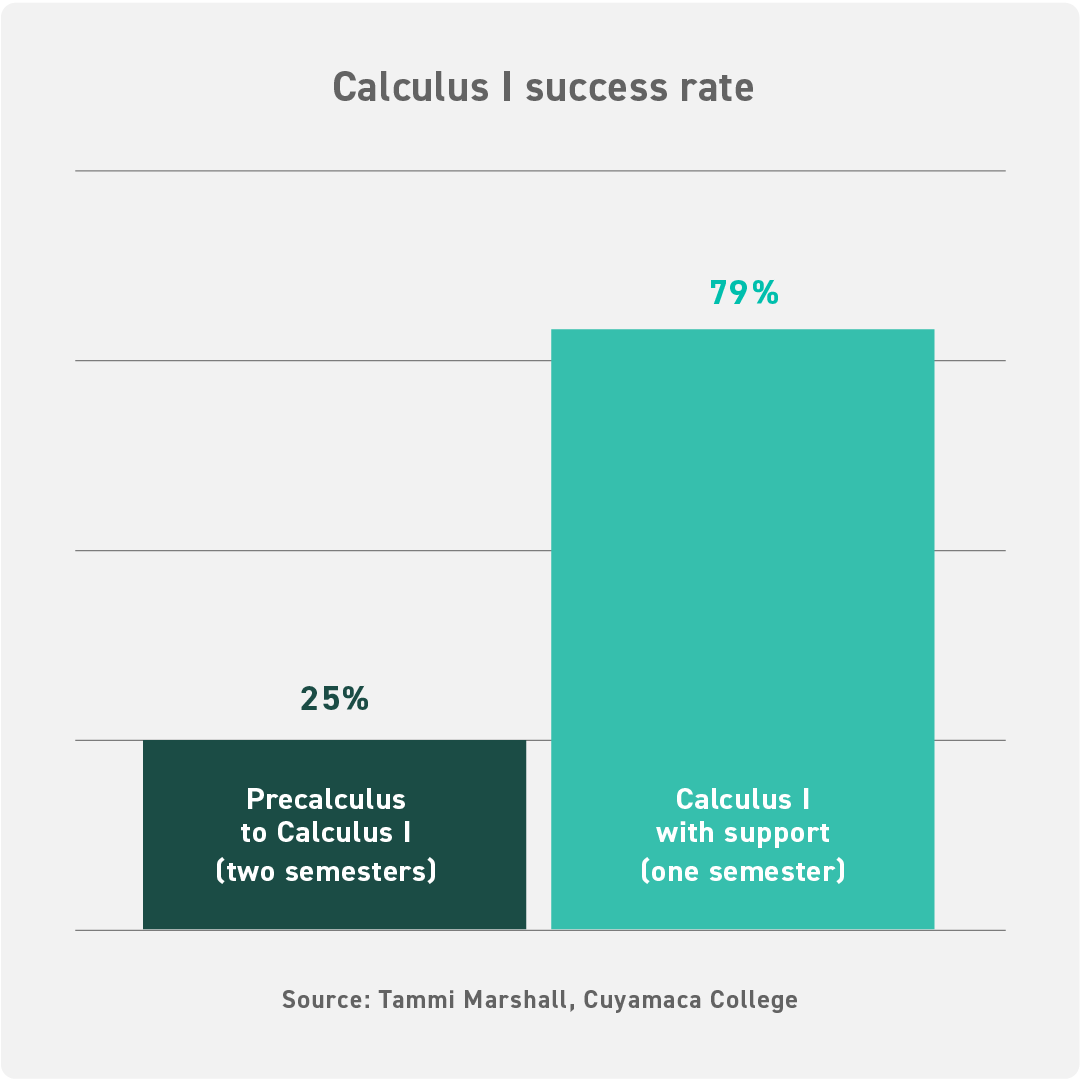
We saw from the data that the approach works. Of students who started in a precalculus course, 25 percent had passed calculus after two semesters— compared to 79 percent in one semester of calculus with support. To ensure that the learning was robust, we followed those students who went on to Calculus II. In the first two years, 61 percent of those who had completed Calculus I with support were successful in Calculus II, compared with 62 percent of students who completed Calculus I without support after taking precalculus.
In addition, while equity gaps remain, they are closing, and students of color have seen an even greater increase in success compared with white students.
We still have more to learn. Now that we have three years of data, we can look more closely at completion and transfer data and continue looking at students’ progression through the calculus series and into physics, engineering, and chemistry.
We won’t stop until we are certain every student has the opportunity to succeed, regardless of whether they feel they are STEM students.
Tammi Marshall is the dean of math, science, and engineering at Cuyamaca College. Since 2010, Marshall and her math department colleagues have been working to redesign Cuyamaca’s developmental math sequence for more equitable placement and completion of transfer-level math.
For more insights on the role of math in ensuring educational equity, subscribe to Just Equations’ newsletter.
