


The conversation about students’ math skills and their readiness for college-level math has become increasingly urgent. Standardized test scores in math are declining, fewer high school students are taking advanced math courses, and college professors and policymakers are raising concerns about whether students are prepared for college-level mathematics.
Addressing these challenges will require us to think differently about how students access rigorous mathematics and how high schools connect that coursework to what comes next.
Dual enrollment may be one answer hiding in plain sight.
There’s good reason to take a closer look. Dual enrollment—defined here as taking college courses while still in high school—addresses several of the challenges at the heart of the issue. It can expand opportunities for rigorous, college-level mathematics, especially for students whose high schools may offer limited advanced coursework options. It can also strengthen the connection between K–12 mathematics and postsecondary expectations, helping students prepare for the college and career paths they choose, particularly in STEM fields.
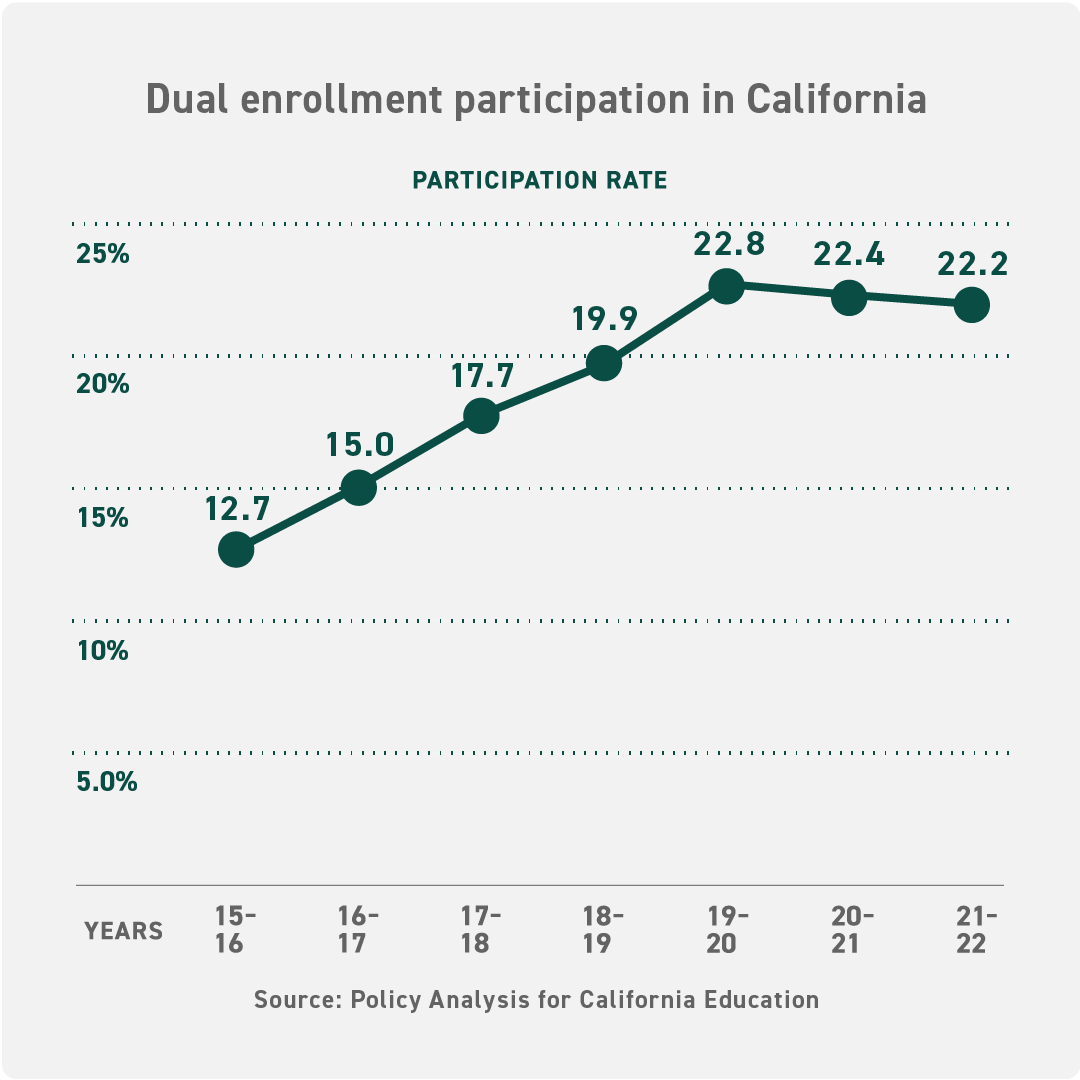
And dual enrollment is no longer a niche opportunity. More than 22 percent of California high school students now participate, up from about 12 percent a decade ago. Research also shows that students across the country who participate in dual enrollment are more likely to enroll in college, persist, and ultimately earn a degree.
Yet dual enrollment in mathematics courses remains relatively uncommon, with only about 3 percent of high school students taking a college math course while in high school. Access to these opportunities remains uneven, with participation more common among students who already have greater access to educational opportunities.
Part of the promise of dual enrollment is that the path into college-level mathematics does not have to look the same for every student. A student preparing for a STEM major may need calculus, while another may benefit from statistics, quantitative reasoning, or other college-level mathematics aligned with their postsecondary goals. Community colleges offer a wide range of mathematics courses related to a variety of postsecondary pathways.
Nationally, while about 40 percent of high school students reach precalculus, just 16 percent complete calculus. In Texas and California, the landscape of advanced mathematics is shifting, with declines in precalculus and calculus participation on the one hand, and growing opportunities for statistics and other alternatives to the traditional calculus pathway on the other.
However, for the last decade, nearly 75 percent of California high school graduates took Algebra II—the minimum math course requirement for admission to the state’s public four-year colleges. For some, meeting the minimum may be sufficient, but for students pursuing STEM fields or seeking admission to more selective colleges and universities, access to and participation in advanced mathematics can be key to meeting their goals.
Expanding options
A student's mathematics pathway is shaped by the opportunities available. Those opportunities depend on the school a student attends, the courses it offers, the guidance the student receives from counselors and teachers, and the resources and staffing available.
The number of California public high schools offering calculus or AP Statistics has declined over the last decade. Many small schools and rural high schools across the country face persistent resource constraints that limit the number and variety of mathematics courses they can offer. Even when schools seek to expand math offerings, many struggle to recruit and retain qualified mathematics teachers. California has faced persistent shortages of credentialed mathematics teachers for years, and at least 39 other states have also reported shortages.
Partnerships with colleges to offer dual-enrollment programs could expand students’ access to mathematics courses. Although dual enrollment is not a substitute for improving K–12 mathematics instruction, it can address several structural barriers that limit student opportunity. Community colleges employ faculty with deep disciplinary expertise and offer a wider range of mathematics courses than many high schools can provide. Moreover, some community college courses are offered online, which could augment the traditional school day and extend access to students in rural and underserved communities.
The push to expand these opportunities is particularly important, because access to advanced mathematics remains deeply uneven.
In California, Asian American students are far more likely than Latinx or Black students to reach Algebra II before graduating (91 percent compared with 71 percent and 69 percent, respectively), and the divide becomes even more pronounced in the courses that follow. Nearly 70 percent of Asian American students take precalculus at some point in high school, compared with just 25 percent of Latinx students and 22 percent of Black students.
Socioeconomic differences are similarly striking. Socioeconomically disadvantaged (SED) students are about 20 percentage points less likely than non-SED students to take precalculus (26 percent versus 46 percent). These disparities are not simply a reflection of the recent decline in advanced-mathematics coursetaking; they have persisted over time and, for some groups, have actually grown. Between 2017 and 2024, precalculus participation among SED students fell by nearly one-third, compared with about one-sixth among non-SED students. The pattern is even more pronounced in calculus, where participation among SED students dropped by nearly 30 percent, while the decline among non-SED students was only about 6 percent.
Equalizing opportunity
Not all dual enrollment is created equal, however.
Dual enrollment may offer one way to broaden access to college-level mathematics, but who benefits depends in part on how opportunities are structured. Research shows that dual enrollment participation is more equitable across racial/ethnic groups when college courses are specifically structured for high school students, particularly when students have access to these opportunities earlier in high school (ninth and 10th grades) or through formal partnerships such as California’s College and Career Access Pathways agreements. This is especially important, as Black, Latinx, low-income, and first-generation college-going students—students with historically fewer opportunities to access rigorous coursework—may benefit the most from dual enrollment.
There are already strong examples of what a more intentional approach can look like. Working across 21 high school–community college partnerships in the Los Angeles and Central Valley regions, College Bridge’s Math Bridge expands access to college-level mathematics, particularly for students who have historically had fewer opportunities. Its sequenced courses and close collaboration between high school teachers and college faculty connect rigorous high school preparation to college-level, credit-bearing mathematics and students’ postsecondary goals.
Expanding dual enrollment may be the key to math preparation.
California has built a strong foundation for dual enrollment, but its potential to strengthen mathematics preparation remains largely unrealized. The challenge is not whether dual enrollment can expand access to college-level mathematics—there is already evidence that it can. The challenge is whether we can expand the community college math courses available to high school students and ensure these opportunities reach students who have historically had the least access to rigorous coursework.
Dual enrollment is not the only solution to the nation’s mathematics challenge, but it is one of the most promising opportunities, and it is already within reach. The question is whether California, and states across the country, will make this kind of opportunity commonplace.
Sherrie Reed is executive director of the California Education Lab at the University of California, Davis School of Education, where she leads research and evaluation on the policies and systems shaping students’ transitions from high school to college and careers in California.
Michal Kurlaender is the Chancellor’s Leadership Professor of Education Policy at the School of Education at the University of California, Davis. Her research focuses on the causes and consequences of educational inequality across a diverse set of educational pathways.
For more insights on the role of math in ensuring educational equity, subscribe to Just Equations’ newsletter.
